Data
To help you solve this year’s Data challenge, we provide the following (logical) datasets:
- Movements (arrival and departure) information for 2025 at 10 major European airports including
- taxi-out time for each movement at the airport and
- scheduled and actual times
PHASE=DEP) or arriving (PHASE=ARR) airport. - Flight information for each movement. This is what is matched in the Network Manager (NM) records.
The movements table rows have been (left) joined with the flight table ones.
There are a total of 4,167,797 movements at the 10 airports as shown in in Table 1.
| ICAO | IATA | Name |
|---|---|---|
| EDDF | FRA | Frankfurt Main |
| EDDM | MUC | Munich |
| EGLL | LHR | London Heathrow |
| EHAM | AMS | Amsterdam Schiphol |
| LEBL | BCN | Josep Tarradellas Barcelona-El Prat |
| LEMD | MAD | Adolfo Suárez Madrid–Barajas |
| LFPG | CDG | Charles de Gaulle |
| LIRF | FCO | Rome–Fiumicino Leonardo da Vinci |
| LTFM | IST | İstanbul |
| LSZH | ZRH | Zürich |
We have removed Military, Head of State, and Sensitive movements. These should not have a disruptive impact on the possibility to model and predict taxi-out time.
Real world data is messy. You will find some inconsistencies between movement and flight information. We haven’t tried to reconcile them because they are probably due to some limitations of the underlying processes trying to match different sources of data.
As per all our data challenges, we do not play with synthetic/artificial datasets.
Buckets
The 2024 PRC Data Challenge website has some instructions about how to use Minio to access OpenSky buckets at
https://ansperformance.eu/study/data-challenge/dc2024/data.html#using-minio-client
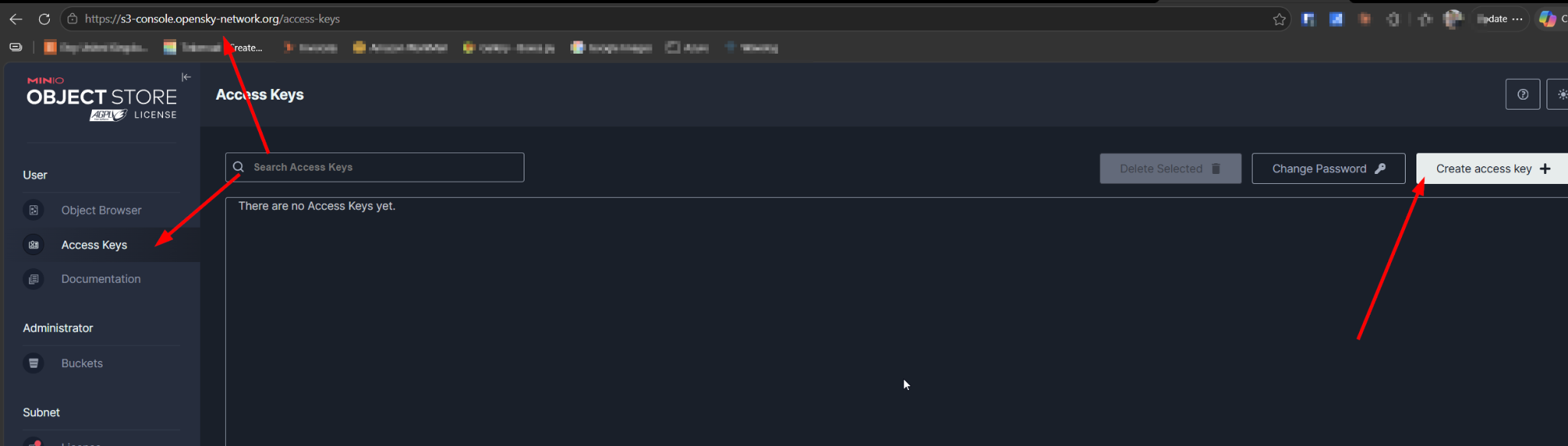
You will need to generate access keys for your OSN account as shown below (thanks to JavierIOM from Discord channel):
The Training Dataset
The training dataset is split into monthly files. Each file contains the movements for the airports of the challenge:
training_2025-01-01_2025-02-01.parquet(21M)training_2025-02-01_2025-03-01.parquet(19M)training_2025-03-01_2025-04-01.parquet(22M)training_2025-04-01_2025-05-01.parquet(23M)training_2025-05-01_2025-06-01.parquet(25M)training_2025-06-01_2025-07-01.parquet(24M)training_2025-07-01_2025-08-01.parquet(25M)training_2025-08-01_2025-09-01.parquet(25M)training_2025-09-01_2025-10-01.parquet(24M)training_2025-10-01_2025-11-01.parquet(25M)training_2025-11-01_2025-12-01.parquet(22M)training_2025-12-01_2026-01-01.parquet(22M)
The Ranking Dataset
The ranking dataset contains the same columns as the training data with:
- Movements for Jan and Jul 2026.
BLOCK_TIME_UTC_mvtandTAXITIME_SEC_mvtfor departures (movements withPHASE="DEP") have been blanked out.
It consists of a single file:
ranking.parquet(27M)
The Submitting Dataset
The submitting dataset is the template to be filled with the predicted taxi-out times, i.e. TAXITIME_SEC_mvt = MVT_TIME_UTC_mvt - BLOCK_TIME_UTC_mvt (for the departure). It only contains the columns MVT_ID_mvt and TAXITIME_SEC_mvt where MVT_ID_mvt values match those of the departures in the ranking dataset. It consists of only one file:
submitting.parquet(1.1M)
The Final Datasets
Same as the ranking and submitting dataset but covering two additional months, February amd June 2026:
final_ranking.parquetfinal_submitting.parquet
Column Description
Columns postfixed with _mvt are associated with the reporting airport.
Columns postfixed with _flt are associated with information from NM flight list.
Movement
MVT_ID_mvt: unique identifier for the movement recordFLIGHT_ID_mvt: unique identifier for the NM flight (if matched)FLIGHT_mvt: flight number, i.e. what you see on your boarding passFLIGHT_RULE_mvt: which sets of regulations the flight is operated under. Possible values are:Ifor Instrument Flight Rules (IFR)Vfor Visual Flight Rules (VFR)NAif unknown
ADEP_mvt: the (ICAO code of the) Aerodrome of DEParture (ADEP).ADES_mvt: the (ICAO code of the) Aerodrome of DEStination (ADES).PHASE_mvt: movement phase.DEP=departure,ARR=arrival.MVT_TIME_UTC_mvt: (best available) movement time (takeoff ifPHASE=DEP, landing ifPHASE=ARR.)BLOCK_TIME_UTC_mvt: block time (off-block ifPHASE=DEP, in-block ifPHASE=ARR.)SCHED_TIME_UTC_mvt: scheduled time (of departure ifPHASE=DEP, of arrival ifPHASE=ARR.)AIRCRAFT_TYPE_mvt: the ICAO code for the aircraft type, for exampleA21Nfor Airbus A321neo.RUNWAY_mvt: the Runway (RWY) ID (of departure ifPHASE=DEP, of arrival ifPHASE=ARR.)STAND_mvt: the stand ID (of departure ifPHASE=DEP, of arrival ifPHASE=ARR.)TAXITIME_SEC_mvt: amount of seconds for taxi time (taxi-out ifPHASE=DEP, taxi-in ifPHASE=ARR.)
Flight
The following columns come from data recorded by NM.
LOBT_flt: last known off-block timeCALLSIGN_flt: the callsign of the relevant flight, e.g.BAW6VB.ADEP_flt: the ICAO code of the ADEP.ADES_flt: the ICAO code of the ADES.ADES_FILED_flt: the ADES initially filed in the Flight Plan (FPL). If different fromADES_flt, then the flight has been diverted.MARKET_SEGMENT_flt: the market segment type as defined in the Market Segment Rules, it can be:- “Mainline”
- “Regional”
- “Low-Cost”
- “Business Aviation”
- “All-Cargo”
- “Charter” (Non-Scheduled)
- “Military”
- “Other”
- “Not classified”
IOBT_flt: Initial Off-Block Time (IOBT).FLIGHT_RULE_flt: which sets of regulations the flight is operated under (see FPL Item 8). Possible values are:Ifor IFRVfor VFRYfirst IFR thereafter VFRZfirst VFR thereafter IFR
FLIGHT_TYPE_flt: flight type (see FPL Item 8). Possible values are:Sfor scheduled air serviceNfor non-scheduled air serviceGfor general aviationMfor military (note: filtered out)Xfor other than the preceding categories
AIRCRAFT_TYPE_flt: the ICAO code for the aircraft type, for exampleA30Bfor an Airbus A-300B2-200.WK_TBL_CAT_flt: wake turbulence category (see FPL Item 9), can be:LLIGHT, i.e. maximum certificated takeoff mass of 7000 kg (15_500 lbs) or less.MMEDIUM, i.e. maximum certificated takeoff mass less than 136_000 kg (300_000 lbs), but more than 7_000 kg (15_500 lbs).HHEAVY, i.e. maximum certificated takeoff mass of 136_000 kg (300_000 lbs) or more (except those specified as J).JSUPER, presently only the AIRBUS A-380-800.
AIRCRAFT_OPERATOR_flt: the (anonymized) ICAO Airline Designator.EOBT_1_flt: the Estimated Off-Block Time (EOBT) for FPL-based (M1) trajectory.ARVT_1_flt: the arrival time for FPL-based (M1) trajectory.AOBT_3_flt: the Actual Off-Block Time (AOBT) for flown (M3) trajectory.ARVT_3_flt: the arrival time for flown (M3) trajectory.
List of Acronyms
ADEP: Aerodrome of DEParture
ADES: Aerodrome of DEStination
AOBT: Actual Off-Block Time
EOBT: Estimated Off-Block Time
FPL: Flight Plan
IFR: Instrument Flight Rules
IOBT: Initial Off-Block Time
NM: Network Manager
RWY: Runway
VFR: Visual Flight Rules